The rapid growth of artificial intelligence is driving unprecedented demand for large-scale computing infrastructure. Hyperscale AI data centers now require gigawatt-scale power capacity, extremely high reliability, and access to sustainable energy sources. Selecting the right location for such facilities is therefore no longer a simple real-estate decision—it is a complex infrastructure planning challenge.
To address this, we have developed a multicriteria methodology for site selection of Green GW-scale AI Data Centers that integrates power systems, digital infrastructure, environmental considerations, and long-term resilience.
A Structured Multicriteria Framework
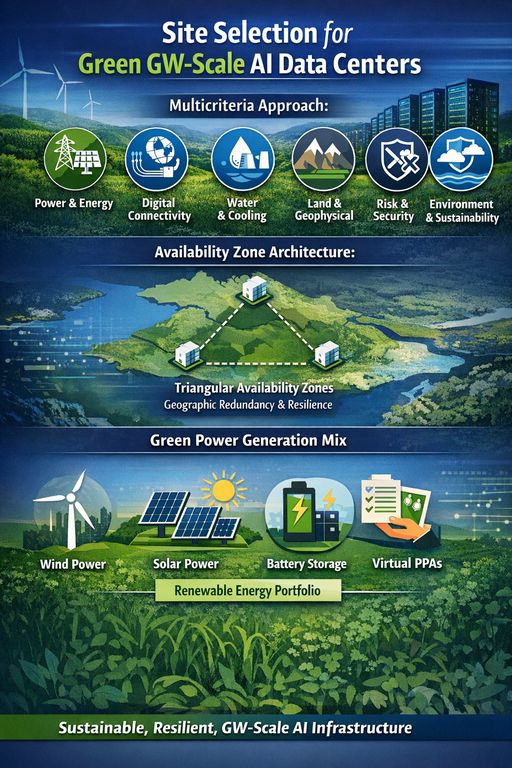
Our approach evaluates potential sites across several key dimensions.
1. Power and Energy Availability
The primary constraint for large AI data centers is access to reliable, affordable electricity. Our methodology prioritizes locations near high-capacity transmission infrastructure (typically ≥400 kV) capable of delivering large volumes of renewable power. Distance to grid nodes, available interconnection capacity, and cost of delivered energy are evaluated early in the screening process.
2. Digital Connectivity
AI data centers require ultra-low latency connectivity to global networks. We analyze proximity to long-haul fiber optic backbones, the availability of multiple network providers, and distance to submarine cable landing stations where applicable. Redundant connectivity paths are essential to meet hyperscale reliability requirements.
3. Water Availability and Cooling Infrastructure
Cooling remains one of the largest operational requirements for data centers. Sites must have reliable and redundant water supply, or access to alternative cooling strategies. Water availability and cost are therefore incorporated into the site ranking process.
4. Land and Geophysical Suitability
Large campuses require significant contiguous land parcels with suitable topography. Our screening excludes areas with steep terrain (slope >5°) and evaluates seismic risk to ensure structural resilience.
5. Risk and Security
Political stability and security risks can significantly impact infrastructure investments. Our framework considers distance from international borders, conflict zones, and other security risks that may affect long-term operations.
6. Environmental and Sustainability Constraints
Environmental stewardship is essential for green infrastructure. Sites overlapping environmentally sensitive areas (ESAs) are excluded, and local ecological considerations are assessed during early screening.
7. Climate Resilience and Site Readiness
Future-proof infrastructure must be resilient to climate risks. Flood risk, sea-level rise, extreme weather exposure, and the readiness of supporting infrastructure are evaluated to ensure long-term operational reliability.
Designing Availability Zones for AI Infrastructure
Beyond selecting individual sites, our methodology also focuses on availability zone architecture.
For AI workloads operating at hyperscale, geographic redundancy is critical. Rather than concentrating all capacity in a single location, we design triangular availability zone architectures—clusters of data center campuses located within regional proximity but separated sufficiently to avoid correlated risks.
This configuration enables:
- High availability and fault tolerance
- Redundant power and network pathways
- Load balancing across multiple campuses
- Resilience against localized disruptions
The result is an AI infrastructure platform capable of supporting mission-critical workloads with hyperscale reliability.
Powering AI with a Green Generation Mix
Achieving truly green AI infrastructure requires more than grid access—it requires a carefully designed renewable generation portfolio.
Our approach combines multiple renewable sources to ensure both sustainability and reliability:
-
Wind power provides strong generation during nighttime and seasonal periods.
-
Solar power complements daytime demand peaks.
-
Battery Energy Storage Systems (BESS) smooth variability and provide short-term dispatch capability.
-
Virtual Power Purchase Agreements (VPPAs) allow operators to secure additional renewable energy capacity beyond the local grid.
By combining these resources, AI data centers can achieve high levels of renewable energy penetration while maintaining the reliability standards required for Tier III or Tier IV facilities.
From Site Selection to Scalable AI Infrastructure
The scale of future AI computing will require integrated planning across energy, connectivity, land, and environmental systems. Traditional data center site selection methods are no longer sufficient.
A structured multicriteria approach allows developers, governments, and investors to identify locations capable of supporting GW-scale green AI infrastructure, while ensuring reliability, sustainability, and long-term resilience.
As AI continues to reshape industries, the ability to plan and build energy-aligned, climate-resilient, and digitally connected data center ecosystems will become a critical competitive advantage for regions seeking to host the next generation of AI infrastructure.
| Attachment | Size |
|---|---|
 IWEInfraSiteSelection-1.jpg IWEInfraSiteSelection-1.jpg | 111.57 KB |