News
The Future of Hydrogen for Seasonal Energy Storage in Grids with Very High Penetration of VRE

Presented “The Future of Hydrogen for Seasonal Energy Storage in Grids with Very High Penetration of VRE” on Nov 4, 2020 at the International Innovative Investment Forum, Innoweek, Tashkent, Uzbekistan.
Forecasting of Renewable Energy Generation Whitepaper

USAID has published a whitepaper that we wrote as part of the Scale Up of Renewable Energy project.
https://www.usaid.gov/energy/auctions/vre-forecasting
It is a primer on variable renewable energy forecasting.
Abstract:
In most grids worldwide, the cost of utility-scale variable renewable energy (VRE) has reached grid parity, matching or beating the cost of fossil fuel–based generation. In others, the cost of VRE is fast approaching grid parity. This phenomenon of falling VRE generation costs is likely to lead to an increase in the penetration of VRE in all grids.
High penetration of VRE is a new phenomenon, as is VRE forecasting. The California Independent System Operator was the first to implement forecasting in 2004.1 Grid operators and policy makers believed high VRE penetrations could be achieved only by having a large amount of reserves, and some even contemplated requiring an amount of reserves equal to the amount of VRE in the grid. The thinking was that since VRE is variable and uncertain, a full backup would be required (making the cost of integrating VRE extremely high).
Fortunately, this did not come to pass, and VRE forecasting can take the bulk of the credit. In advanced VRE markets with accurate forecasting, the increase in statutory reserves is modest, thereby ensuring a modest cost to integrate VRE. For example, the Electric Reliability Council of Texas (ERCOT) reduced its operating reserve requirement through a variety of interventions. These included reducing the forecast lead time and the intervals between dispatches from 15 to 5 minutes.
VRE forecasting has emerged as a cost-effective method for reducing the impact of VRE integration on the grid, and it provides four key benefits that are essential to emerging market grid operators and regulators:
• Reduces reserve requirements needed to manage deviations between dispatched generation and demand, helping supply-constrained systems;
• Improves system flexibility by providing to the system operator accurate VRE generation forecasts, allowing it to optimize the entire generation fleet, which is often unutilized or underutilized;
• Reduces curtailments, allowing more renewables to be economically scheduled; and,
• Increases system reliability because better forecasting allows for significantly lower levels of volatility in the supply-demand balance, resulting in higher overall reliability levels.
VRE forecasting is also a least-cost solution to enhance grid flexibility—a requirement for increased VRE penetration. With accurate day-ahead (DA) and intraday VRE forecasting, decisions about committing, de-committing, or reducing the capacity factors of conventional generators can be made while maintaining high-reliability and low-cost generation. Without VRE forecasting, or with less accurate forecasting processes, it is not possible to adjust the level of production from inflexible conventional generators, leading to the curtailment of VRE. VRE forecasting provides the tools to exploit the flexibility of all conventional generators and thus reduce curtailments and increase VRE penetration.
VRE forecasting has become an indispensable tool for system operators in grids with modest to large amounts of VRE, with and without a real-time power market. The focus of this white paper is on emerging VRE markets with no real-time power market. In such markets, VRE forecasting improves the core functions of system operations: unit commitment, economic dispatch, real-time balancing of supply and demand, and reserves planning. Indeed, VRE forecasting is part of a portfolio of tools and processes that enable the greening of the grid.
For countries that are new to VRE or have not implemented a comprehensive VRE forecasting program, a road map informed by best practices should include:
• Development of policy and regulatory design;
• Addition of VRE forecasting requirements to the grid code;
• A centralized VRE forecasting system pilot project;
• Migration to faster dispatching; and,
• Improvements in weather forecasting.
Since VRE is likely to be a primary source of generation soon, it is recommended that these countries adopt VRE forecasting as a key tool for integrating new or additional VRE into the grid.
VRE Grid Integration Workshop

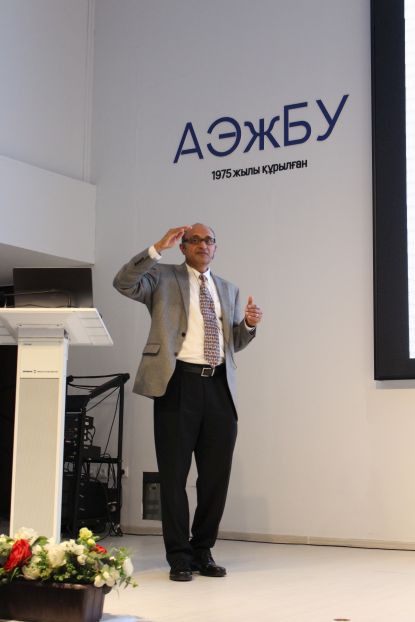
Conducted a workshop on VRE grid integration workshop at the AUPET University in Almaty.
VRE Forecasting Workshop

Conducted a workshop on VRE forecasting at KEGOC. For details see http://ptfcar.org/en/blog/2019/03/renewable-energy-forecasting-workshop/
Workshop in Tashkent on RE Grid Integration

On December 10-11, 2018, Pramod Jain conducted Workshop in Tashkent on "Approaches to the development of electric power sector in Central Asia under high renewable energy penetration scenarios".

Training at KEGOC

On October 16-19, PtF energy experts Mrs. Mariyash Zhakupova and Mr. Pramod Jain conducted training at KEGOC on the DIgSILENT PowerFactory tool and methodology. The training was conducted using KEGOC’s model of the Kazakhstani grid. The purpose of the training was to provide guidance to the KEGOC PowerFactory team on renewable energy generation modeling and analysis of the results. More details
Northern Regional Load Dispatch Center, New Delhi

Conducted a meeting and book signing at the NRLDC, New Delhi.
Bhutan met-mast installation

Completed the inspection of met-mast installations in Bhutan. 2 wind met-masts and 2 solar met-masts were installed as part of the ADB wind and solar measurement and resource assessment project.
Almaty University of Power Engineering and Telecommunications (AUPET)

Conducted workshop on Wind power and grid integration of renewable energy on October 1, 2018 at AUPET in Almaty.
This workshop was organized by the USAID Power the Future Regional Program, implemented by Tetra Tech, in cooperation with the Almaty University of Power Engineering and Telecommunications
Wind Power and Grid Integration of Renewable Energy

USAID Power the Future Program’s workshop opens new horizons for future research for the Almaty University of Power Engineering and Telecommunication.
On October 1, USAID Power the Future Regional Program conducted a workshop on “Wind Power and Grid Integration of Renewable Energy” for professors and students of the Almaty University of Power Engineering and Telecommunication (hereinafter AUPET). Workshop was conducted by world known leading engineer, Mr. Pramod Jain (Phd), for more than 50 Master and Ph.D degree students and professors of the university. More details
Speaker at ACEF 2018

Spoke on Digital Business Models for the Electric Utilities of the Future in the session Transforming from the Old to the New in Energy Systems at the Asia Clean Energy Forum 2018 in Manila. More details
Renewable Energy and Smart Grid Suppliers Forum

IWE's Pramod Jain will be speaker at the Renewable Energy and Smart Grid Suppliers Forum hosted by the US Agency for International Development in Denver, CO on May 1, 2018. More Details