Check out this whitepaper on this topic based on my work on interconnection guidelines:IWE-AI Large Load Interconnection Article.pdf.
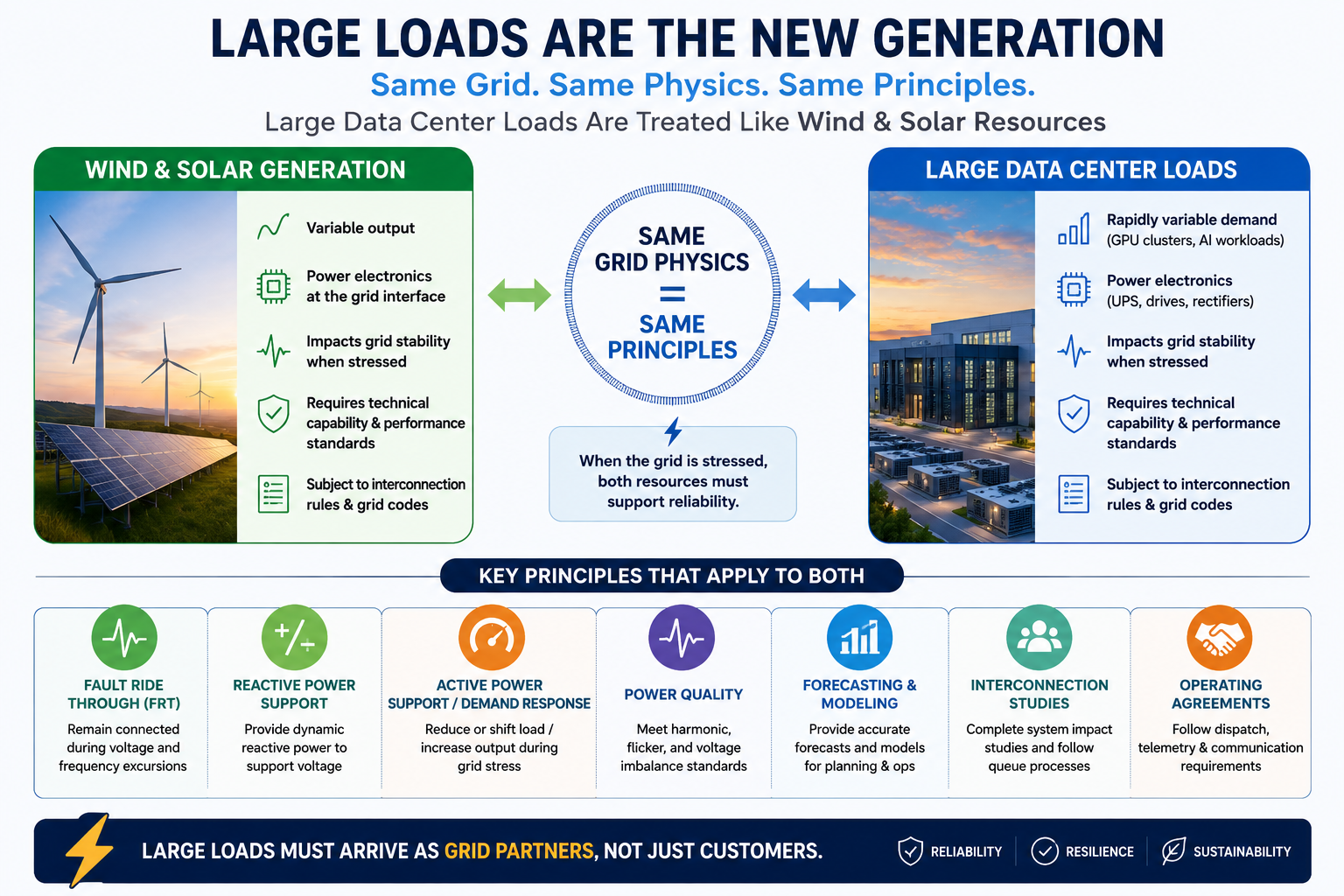
The explosive growth of AI data centers — with single campuses now demanding 1–3 GW of power — has forced a fundamental regulatory reckoning in the U.S. electric grid. Load interconnection, historically a local utility matter outside FERC's jurisdiction, is now squarely a federal concern: gigawatt-scale loads with fast, synchronized variability don't stay local — their disturbances propagate across balancing areas and consume reserves in neighboring grids. In response, DOE directed FERC in October 2025 to initiate rulemaking (ANOPR, Docket RM26-4-000), FERC ordered PJM to overhaul its co-location tariff in December 2025, approved SPP's HILL initiative in January 2026, and committed to a final rule by June 2026. The technical requirements emerging from this process — fault ride-through, reactive power support, demand flexibility as a frequency response equivalent, and ELCC-based accreditation of co-located generation — mirror almost exactly the requirements FERC imposed on large wind and solar plants over the 2012–2024 period, for the same underlying grid physics reasons. On the commercial side, standardized study processes, 100% participant funding of network upgrades, and "bring your own power" co-location structures are becoming the new norm. The right framework — uniform across all ISOs — should be built on a net dependable load obligation principle: a data center's grid obligation is its gross load minus only the ELCC-accredited, firm, behind-the-meter capacity, not its nameplate co-located generation. Done right, large AI loads, with genuine demand flexibility commitments, can be grid assets rather than liabilities — but only if the rules are uniform, technically rigorous, and fairly allocate costs to those who cause them.